
ESOL: Our calls for change
English for Speakers of Other Languages (ESOL) can be life-changing for those who are learning English as a second language. As the Government reviews ESOL provision, our recommendations respond to this opportunity to make English language learning more accessible and relevant to adult learners today.

Changing lives and overcoming exclusion through language education
What's new?

We are looking for a new Chair to provide strategic leadership to our Board at an exciting time for The Bell Foundation. The new Chair would be joining during a period of major development as we build on our work with schools and expand our focus on adult English language learning.

To mark the launch of the University of Reading and Hampshire EMTAS’s new Talk-Rich Teaching Toolkit, Naomi Flynn explores how teachers can create meaningful oracy opportunities for EAL learners. This free resource for schools is now available online.
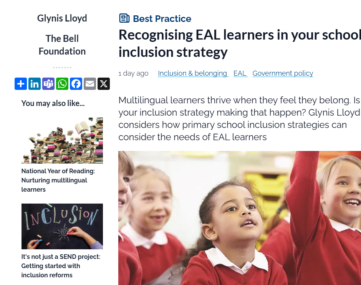
Glynis Lloyd explores how primary school inclusion strategies can consider the needs of EAL learners.

We spoke with Amanda Millican (EMAS) and Dr Eowyn Crisfield (OCME) about the launch of Coventry’s new Language Policy Framework, which brings together English as an Additional Language (EAL), English, modern foreign languages, and home, heritage, and community languages in one coherent framework for schools.
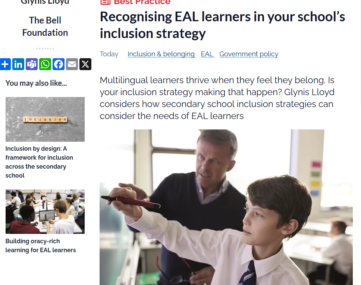
Glynis Lloyd explores how secondary school inclusion strategies can consider the needs of EAL learners.

Inclusion becoming a key theme in education reforms is a positive move forward, especially now that Ofsted evaluates against it. However the more it is used, the easier it is to overlook what it actually means for language. In her recent article for Edge Foundation, Katherine Solomon discusses the barriers EAL learners face, and the importance of inclusive practice from the beginning.
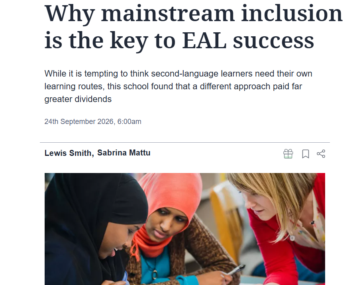
How can schools support students’ English language learning while also ensuring that they feel part of the school community from day one? Barr's Hill in Coventry places KS4 students in higher ability groups and KS3 students in mixed-ability grouping from the moment they join, which has had real a impact on the success of EAL learners. In Tes magazine, EAL practitioners Lewis Smith and Sabrina Mattu explain the different approach taken at their school, where 43% of students use EAL.

Navigating the current AI landscape for teachers can be a challenge. In Gemma De La Cruz-Duffy and Rachel Öner's session at The Bell Foundation conference, they presented how thoughtful prompting can save time, personalise learning, and support more inclusive language teaching, whilst not replacing teacher expertise.

This blog highlights some of our top blogs, resources, guidance, and webinars to help encourage a love of reading and to support EAL learners to develop their reading skills.

Emily Hanson, Head of Education at First News gives advice for how reading can foster belonging for multilingual learners who are new to English, with ideas for both primary and secondary settings.
As multilingual classrooms become the norm, many ECT's feel underprepared to support pupils who use English as an Additional Language. In this article our Policy and Practice Officer, Sheila Hopkins explores three practical strategies that school leaders can use to help build ECT's confidence and strengthen EAL provision.
CEO Diana Sutton’s latest piece for FE Week responds to minister Jacqui Smith’s recent call to prevent devolved authorities from introducing residency requirements for adult education. While this is an important step forward, what this doesn't change is the fact that Greater Lincolnshire still plans to defund ESOL from 2027.
In her latest article for Schools Week, Director of Programmes and Partnerships Katherine Solomon discusses the inclusion of EAL in Ofsted’s “similar schools”. She explains why understanding a child’s English proficiency can provide valuable context and help schools identify how best to support EAL learners to access the curriculum and achieve their potential.

This blog series provides a summary of our recent webinar on effective questioning strategies for international schools.
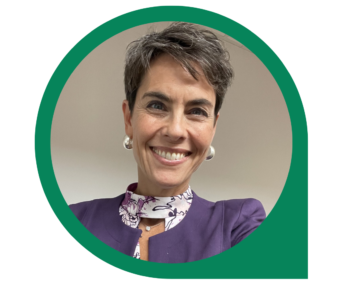
Following her session at our conference, Laura Tarantini-Amor, one of our Licensed Practitioners, explores how the Harris Federation has focussed on overcoming the barriers faced by EAL learners as they respond to the needs of the updated Ofsted Inspection Toolkit.

This blog explains how those who teach English to adults can identify and access suitable ESOL resources.

Slough & Langley College, a finalist in the 2025/26 Beacon Award for Excellence in ESOL, supports adult learners of English to live and work in the UK thanks to its innovative, wraparound ESOL programme.

For our next Practitioner Voices blog series, we hear from Alexandra Slater, EAL and Inclusion Manager at Meadow Park School and Marilena Richards, Advisory Teacher from Ethnic Minority Achievement Service (EMAS), Coventry City Council, about their new paired reading intervention to strengthen the literacy skills and confidence of EAL learners.

Take a look at five recommended EAL reads to inform and inspire your practice over the summer holidays.

This blog highlights some of our top articles, blogs, and guidance for international school teachers - the perfect picks to include for summer reading.

Ahead of our first conference in 2026, we spoke to EAL learners who reflected on their early days in school and shared messages about the small actions, thoughtful approaches, and simple kindnesses that made a lasting difference for them.

For most prisoners, adjusting to the daily routine of prison life is no small thing. For someone who is new to English or in the early stages of English language learning, who may also be very far from home and potentially in a different country from their family and friends, the impact is even more profound.

To mark Gypsy, Roma, and Traveller History Month, we sat down with Sue Wardell, Director of Operations and Development at Suffolk Law Centre, one of our partners and currently in the third year of our grant funded programme which aims to make legal services more accessible to the local Roma community.

Refugee Week 2026 focuses on the theme of Courage. Courage isn’t always loud or bold. It can be found in simple acts. To support this, we’ve brought together a range of EAL resources that reflect the courage of learners from refugee backgrounds.

As part of our Practitioner Voices blog series, we invite our Licensed Practitioners from across the UK to write about their learnings, advice, and thoughts on EAL practice in their setting. Our first guest blog is written by Karolina Piera-Harris, who discusses how a book inspired teaching primary pupils about refugee perspectives.

We outline the key findings of our latest analysis, looking at how other countries approach language provision for those looking to develop proficiency in the language(s) of the country that they are seeking to live in.

This blog is a summary of a webinar presented by Gemma Donovan and Ben Sell from the International Schools Partnership (ISP). The full webinar can be viewed below.

Ofsted’s schools inspection toolkit now includes an explicit focus EAL. Explore our resource hub with practical resources, expert insights, and training to help schools prepare for inspection.

This blog shares practical thinking behind effective, EAL‑inclusive reading practice and key ways for supporting multilingual learners as readers.

The ESOL provision at Oldham College was nominated for a Beacon Award for Excellence in ESOL in recognition of their Community Interpreting course.

This blog explores how annotating texts can be a powerful tool for supporting multilingual learners in a variety of ways.

This blog highlights City of Liverpool College's award-winning ESOL provision, helping diverse learners gain language and vocational skills to integrate into society.
EAL is now back in the Ofsted toolkit, which has implications for schools at their next inspection. We sat down with Mark Sims, former His Majesty’s Inspector, to find out what this means in practice.
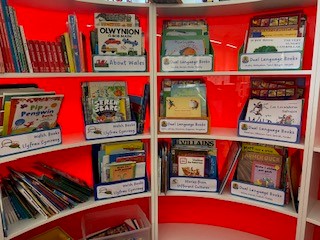
The following guidance mainly refers to primary settings. However, there are some elements that can be applied to secondary settings.

The Bell Foundation celebrates 10 Centres of Expertise nationwide. Emma Dobson, Director of Exceed Teaching School Hub in Bradford, reflects on our partnership and the impact of supporting teachers of EAL learners.

In this opinion piece for FE Week, our Director Diana Sutton explains that Lincolnshire’s move to cut English language learning for non-English speakers won’t help the region’s economy, and why a literacy programme is no replacement.

The Bell Foundation is seeking to expand its network of regional licensed partners running English as an Additional language (EAL) training. We are particularly interested in developing our offer further in London and the South East but welcome Expressions of Interest from other areas too.
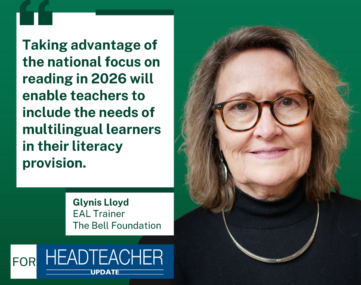
In our latest piece for Headteacher Update, EAL expert and trainer Glynis Lloyd shares practical classroom strategies to strengthen reading for EAL learners – including explicit vocabulary teaching, structured talk to support comprehension, and recognising home languages as assets for learning.

Marking International Mother Language Day, The Bell Foundation highlights how embracing students' Home, Heritage, and Community languages boosts belonging, confidence, and attainment while offering practical ways schools can support multilingual learners.

This blog outlines how early years settings can help EAL learners settle confidently through inclusive environments, play-based language, and family partnerships.

This blog explores how international school leaders can embed multilingualism to build inclusive learning environments where every language is valued.

Read our response to the Greater Lincolnshire Combined County Authority's consultation on its proposed changes to adult skills funding and ESOL within the region.

This ITV story about the realities faced by asylum seeking children in UK schools features a school in Birmingham and how they tailor their provision for this group, as well as an interview with our Director Diana Sutton.

The ITTEC EAL Matrix defines the core knowledge, skills, and behaviours that underpin effective teaching of multilingual pupils who use EAL. It supports Initial Teacher Training (ITT) and Early Career Teacher (ECT) providers to embed consistent, evidence-informed EAL pedagogy across all subjects and phases.

Discover free resources, expert insights, and practical strategies from The Bell Foundation to support reading development for multilingual pupils as part of the National Year of Reading 2026.

This blog outlines the recommendations of Jacob Huckle, Head of Multilingual Learning at Dulwich College Suzhou, who offers a strategic, research-informed vision for what effective leadership looks like in multilingual international school settings.
Why overcoming language barriers matters

Our partners, Pact, speak to an inmate who has participated in the Building Bridges project, which seeks to enhance the accessibility of these courses for speakers of English as a second or additional language (ESL) in prison.

Explore our interactive story to hear from learners, teachers, and experts about what schools can do to remove language barriers for EAL pupils.

In this clip we provide an overview of the current challenges around EAL provision in schools, and we speak to experts and school leaders about their key asks for an incoming government.

In this blog, Giulia Clericetti from Refugee Education UK (REUK) shares how their new ESOL training course, developed in collaboration with The Bell Foundation, has supported volunteer mentors who work with refugees as part of their Educational Mentoring Programme.

In this blog, Andy, a participant in Refugee Action’s Pathways to Work programme, speaks to his mentor, Ross, about what they’ve learned from each other through the programme and how to go about job hunting in the UK.

In this clip we provide an overview of the current challenges around English for Speakers of Other Languages (ESOL) provision, and we speak to experts and students about these challenges and their key asks for an incoming government.

In this blog, we explore lessons from the programme run by the East of England Local Government Association’s Strategic Migration Partnership (EELGA SMP) to support refugees and asylum seekers with employment opportunities.

Rishan and Djafarou, from Kent Refugee Action Network (KRAN), spoke about their experiences since arriving in the UK and the importance of language support.

In this blog, we speak to Harry Jenkins (Senior Researcher) and Elly Townsend (Head of Research & Development) at High Trees about their work, funded by The Bell Foundation, to make ESOL provision more accessible and the exciting findings from their first course.